Dimensions for NBA, FIBA, NCAA Basketball Courts
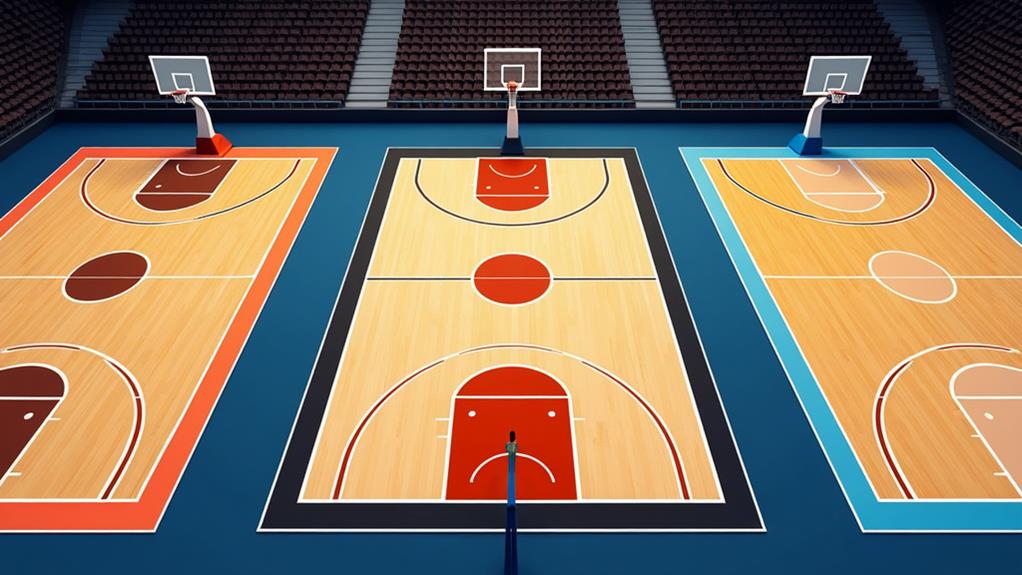
Basketball is a global sport played across different organizations, each with its own set of court specifications. While the game remains largely the same, court dimensions can vary depending on whether the game is played under NBA, FIBA, NCAA, or WNBA rules. These differences can affect gameplay strategies, spacing, and shooting dynamics. These variations can affect player performance and tactical approaches to the game.
| Organization | Court Length (ft) | Court Width (ft) | 3-Point Line (ft) | Free Throw Line (ft) | Key Width (ft) |
|---|---|---|---|---|---|
| NBA | 94 | 50 | 22 ft (corners), 23.75 ft (elsewhere) | 15 | 16 |
| FIBA | 91.86 | 49.21 | 21.65 ft (corners), 22.15 (elsewhere) | 15.09 | 16.08 |
| NCAA | 94 | 50 | 20.75 ft (men), 20.75 ft (women) | 15 | 12 |
| WNBA | 94 | 50 | 21.65 ft (corners), 22.15 ft (elsewhere) | 15 | 16 |
NBA Basketball Court Dimensions
NBA basketball court dimensions are standardized to ensure uniformity across all games. The court measures 94 feet in length and 50 feet in width, ensuring a consistent playing field for all athletes, from rookies to veterans.
The free-throw line is positioned 15 feet from the backboard, with a semi-circle extending 6 feet in radius from this line. This setup provides consistency in shooting during free throws.
The three-point line in the NBA is 23.75 feet from the basket at the top of the arc and 22 feet from the corners, challenging players to hone their long-range shooting skills.
The key, or paint area, is 16 feet wide and 19 feet deep, facilitating effective post play for centers and forwards. Lastly, the rim is 10 feet above the ground, a standard height across all levels of basketball.
WNBA Basketball Court Dimensions
Just like the NBA, the WNBA basketball court dimensions ensure consistency and fairness in the game. The WNBA court size mirrors that of the NBA, measuring 94 feet in length and 50 feet in width. The three-point line is positioned at 22.15 feet from the center of the basket, ensuring players face a similar challenge to their NBA counterparts.
The key dimensions on a WNBA court are also identical to those in the NBA, measuring 16 feet in width and 19 feet in depth. This consistency allows players to transition seamlessly between leagues if the opportunity arises and guarantees uniform playing conditions.
Additionally, the rim height is standardized at 10 feet from the ground across all levels of play, including the WNBA. This standardization, coupled with WNBA courts often sharing arenas with NBA teams, ensures both leagues benefit from consistent playing surfaces and dimensions.
Here's a quick reference table for WNBA basketball court dimensions:
| Component | Measurement | Notes |
|---|---|---|
| Court Length | 94 feet | Same as NBA |
| Court Width | 50 feet | Same as NBA |
| Three-Point Line | 22.15 feet | From center of the basket |
| Key Width | 16 feet | Same as NBA |
| Rim Height | 10 feet | Standard across all levels |
Understanding these dimensions helps appreciate the consistency and fairness integral to WNBA games.
NCAA Basketball Court Dimensions
While NCAA basketball courts share similarities with professional leagues like the NBA and WNBA, there are key differences to note. Both NCAA and professional courts measure 94 feet in length and 50 feet in width, facilitating easier transitions for players between these levels.
However, the three-point line in NCAA basketball is set at 22.15 feet from the basket, a change from the previous 20 feet 9 inches, designed to align more closely with professional standards.
Key aspects of NCAA basketball court dimensions include:
- The key (or paint) area measures 12 feet in width and 19 feet in length, smaller than the NBA's.
- The free-throw line is positioned 15 feet from the backboard, consistent with NBA and WNBA regulations.
- The rim height remains at a standard 10 feet across all levels of basketball.
High School Basketball Court Dimensions
High school basketball courts, while smaller than their collegiate and professional counterparts, adhere to many of the same standards. These courts measure 84 feet in length and 50 feet in width, making them more compact compared to NBA and NCAA courts.
Key elements such as the free throw line are consistent across all levels, positioned 15 feet from the backboard. This consistency helps players develop skills that are transferable as they advance. The key, or paint area, on high school courts is 12 feet wide and 19 feet long, matching NCAA dimensions. This area is crucial for both offensive and defensive strategies, emphasizing footwork and positioning.
The three-point line is set at 19 feet 9 inches from the center of the basket, shorter than in collegiate and professional leagues, making it more accessible for younger players. Unlike higher levels of play, there is no restricted area under the basket in high school basketball.
FIBA Basketball Court Dimensions
FIBA basketball courts are distinct in their measurements, providing a unique playing experience compared to NBA courts. FIBA courts measure 28 meters (approximately 92 feet) in length and 15 meters (approximately 49 feet) in width, which are slightly smaller dimensions than those of NBA courts. This size difference can significantly influence the pace and style of play.
One of the most noticeable features is the three-point line, set at 6.75 meters (22 feet 1.75 inches) from the basket. This distance is shorter than the NBA's three-point line, making outside shooting slightly easier on FIBA courts.
The key, or paint area, in FIBA is also unique. It measures 5.8 meters (approximately 19 feet) long and 4.8 meters (approximately 15.75 feet) wide, differing from the dimensions used in the NBA.
Key points to note:
- The basketball rim height is standardized at 10 feet, the same as in the NBA and NCAA.
- The center court features a tip-off circle with a diameter of 4.2 meters (approximately 13 feet 9.5 inches).
- The smaller court dimensions can lead to a faster-paced game.
Understanding these differences can help you appreciate the unique aspects of international basketball.
History of Court Dimensions
Basketball court dimensions have evolved significantly since the sport's inception. Initially, courts varied greatly in size until standardization efforts in the 20th century unified measurements. Key changes, such as the introduction of the three-point line and adjustments to the key dimensions, have significantly impacted gameplay and strategy over time.
Origins and Early Designs
In December 1891, Dr. James Naismith invented the game of basketball at a YMCA gymnasium in Springfield, MA, on a court that resembled a modified boxing ring. These early basketball courts had no standardized dimensions, resulting in significant variations in size. Some courts were as small as half the size of today's standard courts, reflecting the sport's evolving nature and increasing popularity.
Initially, the dimensions of a basketball court were inconsistent, presenting a new challenge with each game. Imagine playing on a court that differed drastically every time! Early on, the focus was on adapting available spaces for the game rather than adhering to a universal standard.
- No modern markings: Early courts lacked the detailed lines and zones seen today.
- Varied sizes: Courts could be as small as half the size of current standards.
- Boxing ring appearance: The design was simple and functional, resembling a boxing ring more than a modern basketball court.
These early designs laid the groundwork for basketball's evolution. As the game grew, the need for consistent court dimensions became evident, paving the way for the future standardizations that would shape the sport.
Standardization Over Time
Basketball's journey from its inception to becoming a globally recognized sport has been characterized by the gradual standardization of court dimensions. When Dr. James Naismith invented the game in 1891, he used a modified boxing ring, a far cry from today's standard dimensions. As basketball's popularity grew, governing bodies like the NBA, NCAA, and FIBA took steps to unify court dimensions for consistency and fairness.
The NBA and NCAA courts were standardized to 94 feet in length and 50 feet in width. This unified approach ensured that players and fans could expect the same court size regardless of the game's location. The introduction of the 3-point line in the 1979-1980 NBA season marked another significant milestone, with its evolving distance enhancing gameplay strategies over time.
FIBA, the international governing body, opted for dimensions of 28 meters (approximately 92 feet) long and 15 meters (approximately 49 feet) wide, demonstrating some variation in court sizes globally. In 2008, the NCAA adjusted its 3-point line to 22.15 feet from the baseline, aligning more closely with professional standards while still maintaining distinct court specifications.
Impact on Gameplay
The evolution of court dimensions has profoundly impacted basketball gameplay at various levels. NBA courts, measuring 94 feet in length and 50 feet in width, facilitate a fast-paced and expansive style of play, enabling players to showcase a wide array of skills, from explosive drives to long-range shooting.
The introduction of the three-point line significantly transformed offensive strategies. Implemented in the NBA during the 1979-1980 season and in the NCAA in 1986, the three-point line stretched defenses and encouraged perimeter shooting. This shift rewarded outside shooters and opened up the court, fundamentally altering gameplay dynamics.
Smaller court dimensions in high school basketball (84 feet in length) emphasize fluid play and skill development. The reduced space necessitates quicker decision-making and movement, honing essential skills for progression to higher levels of play.
The size of the key also plays a crucial role in gameplay. The NBA's 16-foot-wide key compared to the NCAA's 12-foot-wide key influences post-play strategies. The wider key in the NBA makes it more challenging for big players to dominate the paint, thus affecting how teams approach inside scoring.
- NBA courts: Promote a fast-paced game.
- Key size: Impacts post-play strategies.
- Gameplay dynamics: Change with three-point lines.
Understanding these dimensions allows for a deeper appreciation of the strategic nuances at each level of play.