What Is PER in Basketball?

When evaluating a basketball player's performance, experts often rely on the Player Efficiency Rating (PER), a comprehensive metric designed to encapsulate a player's overall contributions on the court. Created by John Hollinger, PER aggregates various positive statistics like points, assists, and rebounds, and balances them against negative ones like turnovers. This calculation is then normalized per minute to provide a standardized measure. Understanding a player's PER is crucial because it offers a nuanced and reliable indicator of their efficiency and impact during games.
Definition of PER
Player Efficiency Rating (PER) is a comprehensive statistic that quantifies a basketball player's overall performance into a single, easy-to-understand rating. Developed by John Hollinger, PER is a foundational tool in basketball analytics. It adjusts for playing time and pace of play, ensuring a fair comparison among players.
A PER of 15.00 represents the league average, with scores above this mark indicating superior performance. A rating exceeding 35.0 signifies an all-time great season. PER's strength lies in its thorough approach; it considers both positive statistics, like points, assists, and rebounds, and negative statistics, such as missed shots and turnovers.
The formula behind PER is complex, incorporating a range of metrics, including field goal percentage, free throws, and team dynamics. This complexity allows PER to accurately reflect a player's contributions on the court. By balancing various elements of the game, PER offers a holistic view of a player's efficiency and impact.
In essence, PER is a valuable tool for comparing players across different roles, teams, and eras. It simplifies the complexities of basketball performance into a single, meaningful number, making it indispensable for anyone engaged in basketball analytics.
Importance of PER
Understanding the importance of Player Efficiency Rating (PER) is crucial for evaluating a player's overall impact on the game. This comprehensive performance metric allows for the comparison of players across different teams and positions due to its standardized league average. PER also aids analysts, coaches, and teams in making informed strategic decisions regarding trades, drafts, and contracts.
Comprehensive Performance Metric
In basketball analytics, the Player Efficiency Rating (PER) is a crucial metric for evaluating a player's overall impact on the game. PER condenses a player's contributions into a single number using a statistical point value system that accounts for both positive and negative actions. This advanced metric evaluates offensive contributions, such as points, assists, and rebounds, as well as defensive statistics like steals and blocks.
The design of PER provides an all-encompassing view of a player's performance. The league average for PER is set at 15.00, simplifying the identification of above-average and below-average players. A PER above 15.00 indicates a player is performing better than the league average, while a PER below 15.00 suggests underperformance.
One of PER's strengths is its ability to normalize performance based on per-minute statistics and team pace, making it valuable for comparing players across different roles and positions. Widely accepted in basketball analytics, PER helps teams and analysts evaluate player value, potential, and performance. Whether considering trades or player acquisitions, understanding PER can provide a clear edge in making informed decisions.
Player Comparison Tool
The Player Efficiency Rating (PER) is a widely recognized metric for evaluating and comparing player performance across various positions and playing styles. With a league-average PER set at 15.00, the metric allows for quick assessment of a player's value. PER ratings above 30.0 signify exceptional efficiency, often highlighting MVP candidates.
A key advantage of PER is its capacity to compare players from different eras. By adjusting for factors such as team pace and playing time, PER ensures historical accuracy in representing players' statistical achievements and contributions.
Here's a breakdown of different PER categories:
| PER Range | Player Type | Example Players |
|---|---|---|
| 30.0+ | MVP Candidates | Michael Jordan, LeBron James |
| 20.0-29.9 | All-Stars | Kevin Durant, Kawhi Leonard |
| 15.0-19.9 | Average Players | Tobias Harris, Joe Harris |
| 10.0-14.9 | Role Players | P.J. Tucker, Alex Caruso |
| Below 10 | Bench/Developmental | Rookies or fringe players |
Teams and analysts use PER to identify undervalued players in trades, free agency, and draft scenarios. By combining positive and negative stats into a single number, PER provides a comprehensive assessment of a player's overall impact, making it an essential tool for player comparison.
Strategic Decision Aid
Leveraging the Player Efficiency Rating (PER) can significantly enhance strategic decision-making in basketball. PER is a comprehensive metric that evaluates individual player contributions, aiding in informed decisions regarding trades and player acquisitions. With a league average set at 15.00, it becomes straightforward to identify players performing above or below this benchmark.
Using PER strategically allows you to pinpoint undervalued players in the market. High PER scores often indicate players who perform efficiently despite limited opportunities, providing invaluable insights when scouting for new talent or considering trade options.
Importantly, PER evaluates a player's complete contributions during games, offering a holistic view of their effectiveness. This assists coaches and analysts in making smarter lineup decisions, ensuring that the most efficient players are on the court.
PER's ability to compare players across different positions and playing styles makes it an essential tool in drafting and scouting processes. Integrating PER into performance evaluations enhances decision-making strategies for player contracts, trades, and development plans, ultimately aiming for improved team efficiency and competitiveness.
How PER Is Calculated

Calculating Player Efficiency Rating (PER) involves a complex formula designed to capture a player's overall impact on the court. The process starts with the calculation of the unadjusted PER (uPER), which takes into account both positive contributions (such as points, assists, and rebounds) and negative contributions (such as turnovers and missed shots). These statistics are normalized to a per-minute basis to ensure accuracy.
Here's a streamlined view of the uPER calculation process:
| Positive Stats | Negative Stats | Adjustment Factor |
|---|---|---|
| Points | Turnovers | Team Pace |
| Assists | Missed Shots | |
| Rebounds | ||
| Steals | ||
| Blocks |
Career PER Leaders
As of April 2023, Nikola Jokić leads the career PER rankings with a remarkable score of 28.05. Following closely are Michael Jordan and LeBron James, whose scores underscore their long-term excellence. Comparing these top players' PERs provides a clear understanding of their consistent high-level performance and efficiency over time.
Top PER Historical Players
Understanding the top PER historical players provides insight into those who efficiently dominated the game. Leading the pack is Nikola Jokić, whose career PER of 28.05 is the highest ever recorded. Jokić's versatility and impactful play are reflected in this exceptional rating. Right behind him is Michael Jordan, with a PER of 27.91. Jordan's legendary career, marked by his scoring prowess and competitive spirit, makes his high PER no surprise.
LeBron James ranks third with a career PER of 27.08. Since entering the league in 2003, LeBron has consistently delivered high-level performances, showcasing his versatility and longevity. Anthony Davis holds the fourth spot with a PER of 26.96, emphasizing his dominance as a big man. Shaquille O'Neal rounds out the top five with a PER of 26.43, illustrating his sheer dominance during his prime.
| Player | Career PER |
|---|---|
| Nikola Jokić | 28.05 |
| Michael Jordan | 27.91 |
| LeBron James | 27.08 |
| Anthony Davis | 26.96 |
| Shaquille O'Neal | 26.43 |
These historical players highlight how a high PER can define a player's legacy and impact on the game.
Comparing PER Across Eras
Comparing PER across different eras offers a compelling look at how player efficiency has evolved. As of April 16, 2023, Nikola Jokić leads all players with a career PER of 28.05, underscoring his exceptional efficiency. Michael Jordan follows closely with a career PER of 27.91, reflecting his dominance and versatile impact on games.
LeBron James ranks third with a career PER of 27.08, showcasing his sustained high-level performance and versatility. Anthony Davis and Shaquille O'Neal round out the top five with career PERs of 26.96 and 26.43, respectively, highlighting their significant contributions to their teams' success.
Sustained Performance Metrics
Exploring the sustained performance metrics of basketball's elite, the career Player Efficiency Rating (PER) stands out as a crucial indicator of a player's consistent impact on the court. Leading the pack, Nikola Jokić boasts an impressive career PER of 28.05, solidifying his position at the top of this basketball metric. Following closely, Michael Jordan's career PER of 27.91 underscores his efficiency and legendary status in the game.
LeBron James exemplifies sustained excellence with a career PER of 27.08 across his lengthy career. Anthony Davis and Shaquille O'Neal complete the top five with PER ratings of 26.96 and 26.43, respectively, reflecting their enduring excellence and impactful presence on the court.
Other historical figures have also left their mark:
- Wilt Chamberlain: Dominated his era and ranks high in career PER standings.
- Kevin Durant: Consistent scoring and versatility enhance his PER.
- Giannis Antetokounmpo: Modern-day marvel with a high PER reflecting his all-around game.
- Chris Paul: The point guard's leadership and efficiency shine through.
- Tim Duncan: Steadfast contributions cementing his legacy.
These statistical accomplishments highlight the impressive sustained performance of some of basketball's greatest players.
PER in Historical Context

Player Efficiency Rating (PER), created by John Hollinger in the early 2000s, revolutionized the evaluation of player performance in basketball. By standardizing the average PER at 15.00, it allows for more effective comparisons of players across different seasons. However, due to historical data limitations, PER cannot be calculated for NBA seasons prior to 1978. This limitation affects the evaluation of legendary players like Bill Russell and Wilt Chamberlain, whose careers predate the three-point line and comprehensive statistical recording.
PER highlights shifts in player contributions over time and allows teams to assess player efficiency in ways traditional counting stats cannot.
| Player | Highest PER |
|---|---|
| Nikola Jokić | 32.85 |
| Wilt Chamberlain | Not available |
| Bill Russell | Not available |
Only 33 players have ever achieved a PER of 30.0 or higher in a season, with Nikola Jokić holding the highest single-season PER at 32.85. This underscores the rarity and significance of such high efficiency. The introduction of PER marked a significant evolution in sports analytics, providing a more comprehensive method to evaluate player contributions.
Relationship to Sabermetrics
In recent years, the relationship between basketball's Player Efficiency Rating (PER) and baseball's sabermetrics has become increasingly evident. Both metrics emphasize advanced statistics over traditional counting metrics in evaluating player performance. PER, much like sabermetrics, critiques conventional stats by incorporating both positive and negative contributions into a single efficiency metric, providing a more comprehensive view of a player's impact on the game.
PER assesses player performance by considering factors such as minutes played and team pace, akin to how sabermetrics evaluates contributions relative to game contexts. The methodology behind PER includes complex calculations, reflecting the analytical rigor found in sabermetrics, with adjustments for team dynamics and individual performance metrics.
Key points about the relationship between PER and sabermetrics include:
- Influence from Bill James: Principles from sabermetrics have influenced PER's development.
- Holistic Evaluation: PER addresses limitations of basic stats by combining positive and negative contributions.
- Contextual Performance: PER accounts for performance opportunities like game pace and minutes played.
- Analytical Rigor: Both metrics use complex statistical analysis.
- Historical Adjustments: PER's evolution mirrors adjustments in sabermetrics, such as incorporating new statistical elements.
This sophisticated approach ensures an accurate reflection of a player's true value.
Limitations of PER
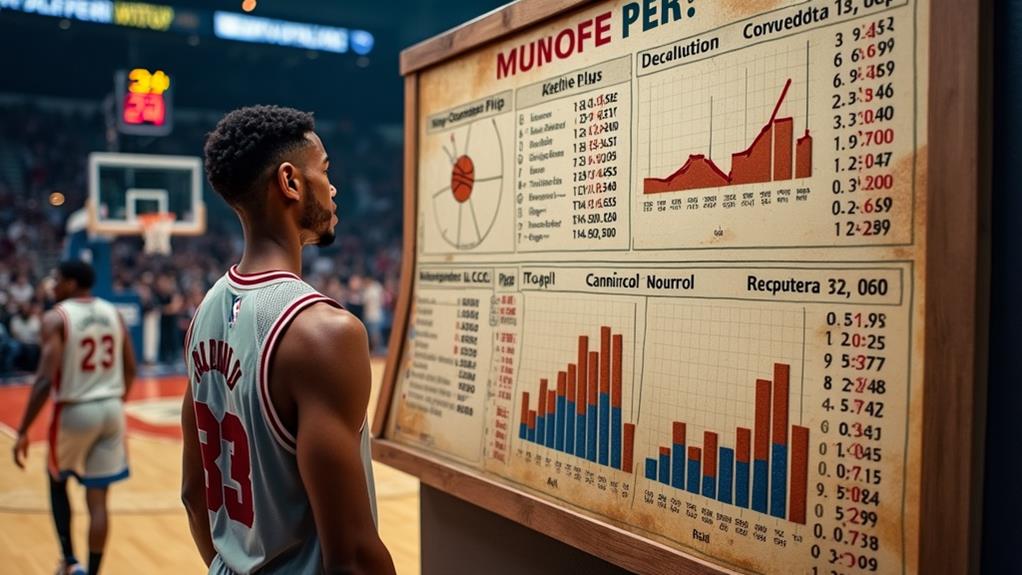
While PER provides valuable insights into a player's offensive capabilities, it has notable limitations that should be recognized. Primarily focusing on offensive performance, PER often undervalues players who excel defensively but lack high offensive statistics. This can be misleading, as defense is a crucial aspect of basketball.
Another limitation is that PER can be skewed by high shot volumes, rewarding players for accumulating points without adequately considering shooting efficiency. As a result, it may misrepresent a player's true value. Additionally, defensive stats like blocks and steals can distort evaluations, as PER does not fully capture the nuances of defensive play and its impact on team performance.
Historical data limitations, such as the absence of three-point shooting statistics in early NBA seasons, further complicate PER comparisons across different eras and playing styles. Critics also argue that PER fails to account for a player's impact in clutch situations or their ability to perform under pressure. These limitations make PER less reliable as a standalone metric for evaluating a player's overall value. Understanding these constraints can help better contextualize PER within its appropriate scope.
Applications of PER
Player Efficiency Rating (PER) has a broad spectrum of practical applications in basketball, helping NBA teams, coaches, analysts, and fantasy sports managers make informed decisions. PER is a trusted metric for evaluating player performance and efficiency, making it a valuable tool across various domains.
Key Applications of PER:
- NBA Teams: Utilize PER to identify undervalued players in trades and free agency, optimizing team roster decisions.
- Coaches: Leverage PER to make strategic decisions by understanding player contributions and how they fit within the team's dynamics.
- Fantasy Sports: Incorporate PER to enhance player rankings, aiding fantasy managers in drafting and managing their teams more effectively.
- Historical Comparisons: Use PER to compare players across different eras, providing a metric for long-term player efficiency and impact on the game.
- Scouting: Complement traditional scouting methods with PER to identify high-efficiency players, aiding in recruitment and development.
Per Vs. Other Metrics

Evaluating player performance in basketball requires a comprehensive understanding of various metrics, and while PER (Player Efficiency Rating) offers valuable insights, it's not the only tool available. PER primarily focuses on offensive performance, giving it a somewhat limited scope in evaluating overall player contributions. Defensive contributions, for example, are not adequately captured by PER. Metrics like Defensive Rating (DRtg) offer a clearer picture of a player's defensive impact, highlighting PER's limitations in assessing overall player value.
For a broader context of a player's impact on team success, Win Shares might be more useful. Unlike PER, Win Shares estimate the number of wins a player produces, providing a clearer sense of how a player contributes to their team's victories. Similarly, Box Plus/Minus (BPM) combines both offensive and defensive contributions, offering a more comprehensive view of a player's overall impact on the game.
Other advanced metrics like True Shooting Percentage (TS%) and Player Impact Estimate (PIE) provide additional layers of detail. TS% measures scoring efficiency, while PIE incorporates factors like usage rate and minutes played, offering a more nuanced evaluation. While PER remains popular, these other metrics provide valuable perspectives on player contributions.