What Is Win Shares in Basketball?

Win Shares in basketball is a statistic that quantifies a player's overall contribution to their team's victories. Developed by Justin Kubatko in 2006, Win Shares are divided into Offensive Win Shares (OWS) and Defensive Win Shares (DWS), offering a balanced view of a player's impact on both offense and defense. This metric facilitates meaningful comparisons across different players and eras, making it a valuable tool for teams during contract negotiations and trades. Curious about how this calculation works and its implications? Let's delve deeper.
Definition of Win Shares
Win Shares (WS) is a comprehensive statistic developed by Justin Kubatko to assess a basketball player's overall impact on their team's success. It integrates a player's offensive and defensive contributions along with their playing time to quantify their contribution to team victories.
One Win Share equates to one-third of a team win. Therefore, if a team secures 60 victories in a season, their total Win Shares should approximate 180. This metric helps illustrate a player's value in terms of the number of wins they contribute to their team. Players accumulate Win Shares in two categories: Offensive Win Shares and Defensive Win Shares, providing a detailed evaluation of their impact on both ends of the court.
For standardized comparisons, the WS/48 metric calculates Win Shares per 48 minutes of play. This allows for effective comparisons between players with varying amounts of playing time, enabling fair assessments of those with limited minutes but high productivity against those with more playing time.
Kareem Abdul-Jabbar holds the record for career Win Shares with 273.4 and the single-season record of 25.4 Win Shares during the 1971-72 season, underscoring his significant contribution to team wins.
History and Origin
Win Shares in basketball, inspired by Bill James' original concept for baseball, were introduced by statistician Justin Kubatko on Basketball-Reference.com in 2006. This adaptation has since become a vital metric for assessing player contributions, highlighting the increasing significance of advanced analytics in the sport.
Bill James' Innovation
In the realm of sports analytics, Bill James' innovative approach to baseball player evaluation revolutionized the field. His development of Win Shares offered a new way to quantify player contributions to team success. Initially formulated for baseball, this metric was later adapted for the NBA by statistician Justin Kubatko.
Kubatko tailored Bill James' methodology to fit the dynamics of basketball, focusing on both offensive and defensive contributions. Key adaptations included:
- Direct correlation: In basketball, one win share corresponds to one-third of a team win, directly linking individual performance to team success.
- Performance statistics: The evaluation incorporates comprehensive performance data to assess contributions.
- Offensive and defensive balance: It considers players' roles on both ends of the court.
- WS/48 metric: Win shares are standardized over 48 minutes of play, enabling fair comparisons among players with varying playing times.
Evolution to Modern Metrics
Basketball analytics have significantly advanced since the inception of Win Shares, a concept developed by Justin Kubatko and inspired by Bill James' baseball methodology. Win Shares quantify individual player contributions to team success, adapting to basketball's nuances by focusing on scoring, rebounding, and defense.
Win Shares consist of both offensive and defensive components. Offensive Win Shares measure a player's scoring contributions, while Defensive Win Shares assess their ability to prevent opponents from scoring. This dual approach offers a comprehensive view of a player's overall impact.
A notable advancement in this metric is the introduction of Win Shares per 48 minutes (WS/48), allowing fair comparisons between players with varying playing times by standardizing efficiency.
As basketball analytics evolved, Win Shares became integral in evaluating player performance and team dynamics, influencing evaluations and strategic decisions by highlighting the importance of both offensive and defensive contributions.
Key Components:
| Metric | Description | Importance |
|---|---|---|
| Win Shares | Overall player contribution to team wins | Comprehensive player impact |
| Offensive Win Shares | Contribution to team scoring | Measures offensive performance |
| Defensive Win Shares | Effectiveness in preventing opponent scoring | Measures defensive performance |
| WS/48 | Win Shares per 48 minutes played | Enables fair efficiency comparison |
| Advanced Analytics | Modern metrics for holistic evaluation | Informs decisions and strategy |
This structured approach ensures a balanced and accurate assessment of player contributions, enhancing the trustworthiness and relevance of the analysis.
Calculating Win Shares
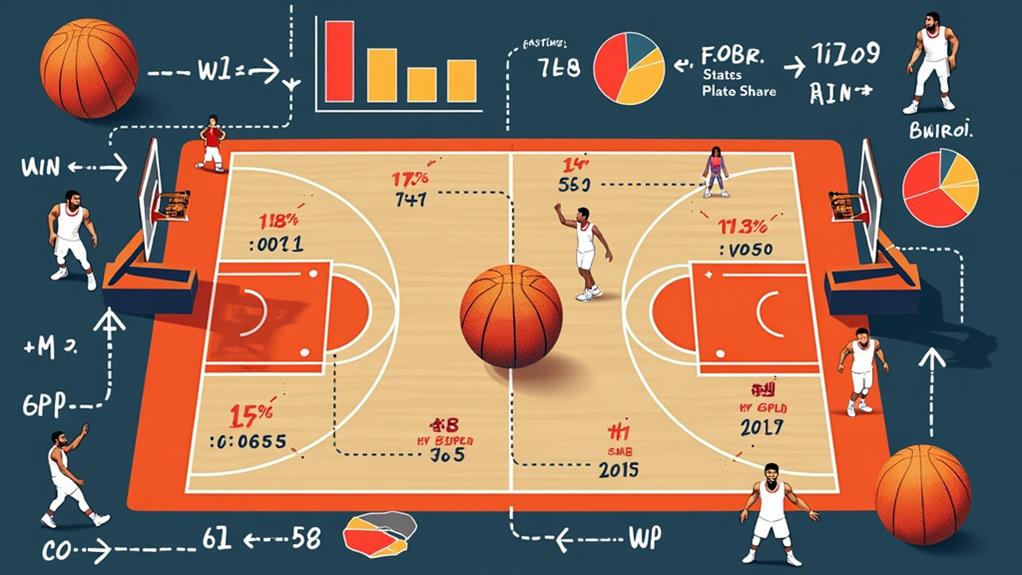
To understand Win Shares, you must know how both Offensive and Defensive Win Shares are calculated. Offensive Win Shares evaluate a player's points produced and their efficiency in using offensive possessions. Defensive Win Shares use a player's Defensive Rating to estimate points allowed and assess their marginal defensive performance. Combining these metrics provides a comprehensive view of a player's contributions to team wins.
Offensive Win Shares Calculation
Understanding how Offensive Win Shares are calculated involves analyzing a player's offensive production and efficiency. The process includes evaluating the total points a player produces during a season and the offensive possessions they use.
Here's a simplified breakdown:
- Points Produced: The total number of points a player is responsible for, including their own scoring and assists.
- Offensive Possessions Used: The total offensive possessions a player utilizes.
- Marginal Offense: This figure is calculated by subtracting 0.92 times the league's points per possession from the player's total points produced.
- Marginal Points per Win: This converts the marginal offense into a win value.
For example, during the 2008-09 season, LeBron James produced an estimated 2,345.9 points, resulting in 13.73 Offensive Win Shares. This metric helps quantify the number of wins attributable to a player's offensive contributions.
Defensive Win Shares Calculation
When calculating Defensive Win Shares, the process revolves around a player's Defensive Rating, which estimates how many points they allow per 100 defensive possessions. This metric offers a clear insight into a player's defensive prowess. To compute Defensive Win Shares, you need to evaluate the player's contributions to team defense, considering total defensive possessions and the league's average points allowed per possession.
A crucial component of this calculation is determining the marginal defensive impact, which measures the number of points a player prevents compared to league averages. For instance, if a player has a Defensive Rating of 99.1, it indicates they allow fewer points than the average player, thus positively influencing their Defensive Win Shares.
The total Defensive Win Shares are obtained by aggregating these defensive contributions, providing a comprehensive view of the player's defensive effectiveness. Essentially, a lower Defensive Rating correlates with higher Defensive Win Shares, signifying a stronger defensive performance. By understanding and calculating these metrics, you can more accurately gauge a player's defensive value within their team and across the league.
Offensive Win Shares
Offensive Win Shares (OWS) provide a precise measure of a player's impact on their team's scoring success. This metric evaluates the extent to which a player's offensive contributions translate into team wins by focusing on points produced and offensive possessions used during a season. By isolating these contributions, OWS offers a clear assessment of a player's efficiency and effectiveness on the offensive end.
To calculate OWS, analysts consider the player's points produced and their offensive possessions. The formula involves marginal offense, calculated by subtracting 0.92 times the league's points per possession from the player's points produced and then multiplying by the player's offensive possessions. This yields a tangible number representing the player's offensive contributions.
For example, during LeBron James' 2008-09 season, he produced an estimated 2,345.9 points, resulting in 13.73 Offensive Win Shares. This exemplifies his significant impact on his team's scoring success.
Key aspects of OWS include:
- Efficiency: Evaluates how well a player converts possessions into points.
- Effectiveness: Measures the total contribution to team scoring.
- Comparison: Facilitates comparisons of offensive prowess among players.
- Team Success: Links individual scoring efforts to team wins.
Defensive Win Shares

Defensive Win Shares (DWS) provide critical insight into a player's effectiveness in preventing the opposing team from scoring. This metric quantifies a player's defensive contributions by examining factors such as defensive rating and points allowed per 100 possessions. By assessing individual defensive performance and its impact on team defense, DWS offers a comprehensive view of a player's role in enhancing the team's overall defensive efficiency.
For example, during the 2008-09 season, LeBron James achieved a Defensive Rating of 99.1, contributing 6.54 Defensive Win Shares. This underscores how DWS can highlight a player's substantial influence on their team's defensive success. It goes beyond personal stats to show how these contributions translate into meaningful team performance enhancements.
DWS is particularly valuable for evaluating players who may not excel offensively but are defensive specialists. These players can significantly impact their team's success by limiting opponents' scoring opportunities. By merging individual defensive metrics with team success, DWS provides a thorough understanding of a player's ability to contribute to winning through defense. Thus, DWS is an essential tool for analyzing players' total impact and their contributions to their team's defensive strength.
Importance of Win Shares
Understanding Win Shares is essential for evaluating player efficiency and assessing their true impact on team success. This metric simplifies comparing players across different eras and positions, providing a clearer picture of their contributions. Additionally, Win Shares can guide decisions on contracts and trades by identifying undervalued players, ensuring more informed and strategic decision-making.
Evaluating Player Efficiency
Win Shares (WS) is a comprehensive metric that quantifies a player's overall contributions to their team's success by integrating both offensive and defensive performance into a single statistic. This holistic approach enhances the evaluation of player efficiency. By utilizing the WS/48 metric, which calculates win shares per 48 minutes played, comparisons of player efficiency can be standardized, making it particularly useful for assessing players with varying playing times.
A player's total Win Shares are composed of two key components:
- Offensive Win Shares: Quantifies a player's contributions to their team's scoring.
- Defensive Win Shares: Measures a player's effectiveness in preventing opponent scoring.
These components underscore the dual impact of players on both ends of the court. Historical data, such as Kareem Abdul-Jabbar's record 273.4 career Win Shares, illustrates the long-term impact of elite players, underscoring the importance of WS in evaluating player efficiency.
Win Shares also play a crucial role in strategic decisions related to player contracts and trades. They offer a quantitative foundation for assessing player efficiency and effectiveness in relation to team success, thereby aiding in the construction of a winning roster.
Impact on Team Success
When evaluating a team's success, the fundamental role of individual player contributions, quantified through Win Shares, cannot be overlooked. Win Shares allocate a portion of a team's wins to individual players based on their offensive and defensive performances, underscoring the importance of each player's efforts in achieving overall team success.
Consider an All-Star player who accumulates around 20 Win Shares in a season. This metric goes beyond mere statistics; it signifies the player's substantial influence on the team's ability to secure victories. Higher Win Shares totals indicate a more significant impact by an individual player on team success.
| Player | Win Shares | Team Wins | Contribution to Wins |
|---|---|---|---|
| Player A | 20 | 60 | 1/3 |
| Player B | 15 | 60 | 1/4 |
| Player C | 10 | 60 | 1/6 |
| Player D | 5 | 60 | 1/12 |
| Player E | 1 | 60 | 1/60 |
The focus of Win Shares on both offensive and defensive contributions ensures a comprehensive evaluation of a player's impact. Analyzing Win Shares aids teams in making informed decisions regarding player contracts and trades, identifying those who significantly enhance team performance relative to their market value.
Comparative Player Analysis
Win Shares offer a comprehensive metric for evaluating a player's overall impact on team success by combining both offensive and defensive contributions into a single value. This makes it easier to compare players' effectiveness, regardless of their playing time.
Key considerations include:
- Win Shares highlight the value of players who excel in defense and playmaking, even if their scoring is modest.
- Historical legends like Kareem Abdul-Jabbar and Michael Jordan accumulated substantial Win Shares, reflecting their dominance.
- The metric can identify players with negative contributions, aiding teams in addressing weaknesses.
- Defensive contributions are recognized within Win Shares, ensuring defensively skilled players receive due credit.
Win Shares significantly influence contract and trade decisions by emphasizing a player's long-term positive impact on team outcomes. This metric provides a reliable way to measure and compare the true influence of both star players and under-the-radar contributors.
WS/48 Metric
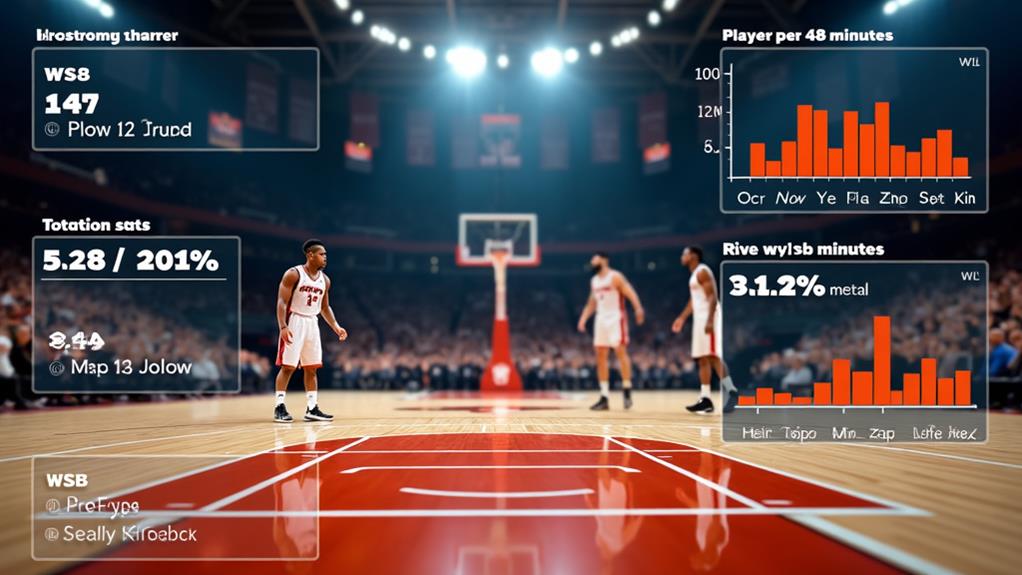
Investigate the WS/48 metric, a powerful tool for evaluating player efficiency in basketball. Win Shares per 48 minutes (WS/48) standardizes win shares to a per-game basis, facilitating the comparison of players with varying playing times. This metric helps identify how effectively a player contributes to team success during their time on the court.
To calculate WS/48, divide a player's total win shares by their total minutes played, then multiply by 48. This method ensures that players who play fewer minutes but make significant contributions are not overlooked. High WS/48 values often highlight players who excel in scoring, defense, and overall impact. Legends like Michael Jordan and LeBron James frequently boast impressive WS/48 figures due to their remarkable efficiency and influence on games.
Using WS/48, you can pinpoint high-impact players who might not play extensive minutes but still drive team success. This metric provides a clear lens into player efficiency, revealing who truly makes the most of their time on the court. In conclusion, WS/48 is an invaluable tool for evaluating and comparing player contributions to wins in basketball.
Applications in Basketball
Let's delve into how Win Shares (WS) are practically applied in basketball. Win Shares quantify a player's overall contribution by combining both their offensive and defensive impacts, providing a comprehensive metric for teams and analysts.
For example, when evaluating player efficiency, Win Shares offer a clear measure of how much a player contributes to winning games. Since the total Win Shares for a team is roughly equal to three times the number of wins, it provides a straightforward way to gauge individual contributions relative to team success.
Here are some key applications:
- Contract and Trade Decisions: Win Shares help teams make informed decisions about player contracts and potential trades by highlighting each player's true value.
- Injury Impact Analysis: Assess how a player's absence might affect team performance and develop strategies to mitigate the impact.
- Player Comparisons: WS/48 allows for standardized comparisons, making it easier to evaluate players with different amounts of playing time.
- Thorough Evaluation: Offensive and Defensive Win Shares offer a detailed view, ensuring no aspect of a player's game is overlooked.
Criticisms and Comparisons

Win Shares' methodology has its critics, with some arguing that it fails to account for negative contributions, potentially overlooking how poor performances can harm a team. This lack of provision for negative win shares means that a player who negatively impacts their team isn't penalized adequately in the metric, potentially skewing evaluations.
Additionally, Win Shares allocates 52% of its credit to defensive contributions and 48% to offensive ones. Critics argue that this emphasis on defense may not accurately reflect a player's comprehensive impact, especially when considering marginal defense. Some believe this imbalance can misrepresent a player's true value, particularly if their defensive prowess isn't as significant as their offensive contributions.
The metric also tends to give players on overachieving teams more credit for team success. When a team performs better than its Pythagorean expectation, individual players' win shares can be inflated, raising questions about the metric's reliability.
Compared to other metrics like WAR (Wins Above Replacement), which focuses on individual skill, Win Shares emphasizes contribution to team victories. This can result in differing interpretations of player impact. In contrast, OPS in baseball highlights individual performance, leading to ongoing debates about which approach better evaluates player effectiveness.
Further Reading and Resources
For those interested in delving deeper into the intricacies of Win Shares, several valuable resources can enhance your understanding. Gaining insight into how Win Shares quantifies player contributions is essential for appreciating its impact on basketball analytics.
One of the most authoritative sources is Basketball-Reference.com. This website offers extensive statistical breakdowns and historical data, allowing you to analyze Win Shares and their influence on player rankings and team dynamics. You can find detailed explanations of the Win Shares calculation method, including points produced, offensive possessions, and defensive ratings, which thoroughly quantify a player's impact.
Here are some useful resources for further reading:
- Basketball-Reference.com: Provides in-depth tables and historical data on Win Shares and WS/48, ideal for comparative analysis.
- Books and Articles by Justin Kubatko: As the creator of Win Shares, Kubatko's work offers foundational knowledge and insights.
- Advanced Basketball Statistics Textbooks: These books cover various metrics, including Win Shares, offering a broader context for player evaluation.
- Online Basketball Analytics Communities: Forums and blogs where analysts discuss and debate the application and nuances of Win Shares.
These resources will help you gain a comprehensive understanding of Win Shares and their significance in basketball analytics.