What Have Been the Most Unusual Games in NBA History?
When considering the most unusual games in NBA history, several matchups stand out for their unpredictability and bizarre circumstances. For instance, in a 2014 game between the Lakers and Cavaliers, Robert Sacre fouled out but had to remain on the court due to roster limitations. In another peculiar instance, the Thunder staged an incredible comeback against the Rockets, who scored just 19 points in the entire second half. Additionally, a 2015 game between the Heat and 76ers saw both teams seemingly trying to lose. These unique events make one ponder what other oddities have occurred on the hardwood over the years.
Lakers Vs Cavaliers, 2014
The February 5, 2014, game between the Lakers and Cavaliers became one of the most unusual matchups in NBA history due to a rare occurrence involving Robert Sacre. After fouling out, Sacre remained on the court because the Lakers had no available substitutes, adhering to the NBA rule that requires a team to field at least five players. Consequently, Sacre was assessed personal and team fouls for each subsequent infraction.
This led to the Lakers receiving technical fouls every time Sacre committed another foul, creating a peculiar and memorable situation. Fans and analysts were astounded, and the game became a focal point for discussions about the rigidity of NBA rules when teams face severe roster limitations.
The matchup between the Lakers and Cavaliers is a prime example of how strict rule enforcement can lead to bizarre scenarios. It highlighted the complexities and sometimes unexpected outcomes of NBA regulations.
Thunder Vs Rockets, 2014
While the Lakers vs. Cavaliers game in 2014 had its own drama, the Thunder vs. Rockets clash on January 16, 2014, delivered a true rollercoaster experience. The Houston Rockets dominated the first half, leading the Oklahoma City Thunder with a score of 73-59, suggesting a smooth path to victory.
However, the second half flipped the script entirely. The Rockets managed to score only 19 points after halftime, a sharp decline that left fans and analysts stunned. Seizing the opportunity, the Thunder rallied to win the game 104-92. This dramatic shift set an unwanted NBA record for the largest point differential between halves.
The Thunder's persistence paid off as they improved their shooting to 42.5% in the second half, compared to the Rockets' sharp decline. This game highlighted the extreme unpredictability and inconsistencies that can occur in NBA matchups. It wasn't just about the points scored; it was about how the Thunder vs. Rockets game showcased the highs and lows that make basketball so exhilarating to watch.
Heat Vs 76ers, 2015
How often do you see teams intentionally trying to lose? In a bizarre twist on April 15, 2015, the Miami Heat and Philadelphia 76ers faced off with an unusual goal: tanking for better lottery picks. Both teams made unconventional substitutions and took player management to an extreme.
The 76ers benched their star player, Nerlens Noel, and handed significant responsibilities to rookie Joel Embiid, who didn't even play due to injury. This set the tone for a game that defied typical competitive spirit. On the other side, the Miami Heat rested all their star players, opting to field the last five players on their roster. This decision underscored the lengths teams will go to secure a brighter future.
Despite both teams' strategic efforts to lose, the 76ers ultimately lost the game, highlighting the inherent unpredictability of tanking strategies. This game became a notable example of unusual player management and the tactics teams can employ. The Heat vs 76ers matchup in 2015 remains one of the most peculiar in NBA history, illustrating how far teams will go in pursuit of better draft positions.
Malice in the Palace, 2004
View this post on Instagram
On November 19, 2004, NBA history witnessed one of its most infamous moments: the Malice in the Palace. This notorious brawl between the Detroit Pistons and the Indiana Pacers erupted after Ron Artest fouled Ben Wallace. Wallace retaliated, igniting tensions on the court. The situation spiraled out of control when a fan threw a cup at Artest, prompting him to charge into the stands. This act led to multiple players, including Stephen Jackson, joining the fray, resulting in widespread chaos.
The Malice in the Palace wasn't just a game; it was a turning point in NBA history. The aftermath saw numerous suspensions for the players involved, with Artest receiving the longest suspension in NBA history at 86 games. This incident forced the NBA to reevaluate and change its policies regarding player conduct, fan interactions, and security measures during games.
The Malice in the Palace remains one of the most unusual and significant events in NBA history.
Warriors Vs Blazers, 2010
On April 14, 2010, the Warriors faced the Blazers with only six active players. Despite the roster limitations and injuries, Steph Curry and Monta Ellis combined for an impressive 76 points. In an unusual NBA rule enforcement, Devean George continued to play after fouling out. The Warriors secured an overtime victory, demonstrating remarkable resilience.
Roster Limitations and Injuries
Despite significant roster limitations on April 14, 2010, the Golden State Warriors exhibited remarkable resilience against the Portland Trail Blazers. With only six active players available due to injuries, and starting center Chris Hunter getting injured early, the Warriors were reduced to five players who had to log significant minutes. This dire situation didn't deter Steph Curry and Monta Ellis, who put on a spectacular show. Curry scored 42 points, while Ellis added 34 points, carrying the team on their backs.
In a game filled with fouls, Devean George fouled out but was allowed to return under an unusual NBA rule. Despite their challenges, the Warriors managed to pull off a stunning overtime victory with Steph Curry scoring 42 points. Their incredible effort in overcoming roster limitations, injuries, and a high number of fouls, while making numerous free throws, led them to a memorable overtime win.
Hawks Vs Heat, 2007
Imagine watching a game where a bookkeeping error changes everything. In the Hawks vs. Heat matchup on December 19, 2007, a foul misassignment led to the NBA mandating a replay of the final 51.9 seconds. This rare scenario resulted in a unique double game night, with fans witnessing two segments in one evening, underscoring the importance of accurate statistics in the league.
Critical Bookkeeping Error
During an NBA game between the Hawks and the Heat on December 19, 2007, a critical bookkeeping error led to significant confusion. Shaquille O'Neal's sixth foul was mistakenly attributed to his teammate Udonis Haslem, allowing O'Neal to remain in the game and impact its outcome.
Key points to understand:
- Bookkeeping Error: The error of assigning O'Neal's sixth foul to Haslem permitted O'Neal to continue playing.
- Impact of Shaquille O'Neal: O'Neal's continued presence on the court altered the game's dynamics, given his dominance as a player.
- Udonis Haslem: Haslem wrongly received the foul and continued to play with fewer fouls than he actually had.
- Replayed Segment: The NBA decided to replay the final 51 seconds of the game months later, an unprecedented move in NBA history.
This bookkeeping blunder is a notable event in NBA history due to its rarity and the subsequent decision to replay the final moments. In the replayed portion, the final score was Hawks 114, Heat 111, with no additional points scored by the Hawks. This unique occurrence allowed fans to experience two games in one night, making it one of the most unusual moments in NBA history.
Replaying Final 51 Seconds
The bookkeeping error during the game between the Hawks and the Heat on December 19, 2007, set the stage for an unprecedented event in NBA history. Due to a crucial mistake, Udonis Haslem was incorrectly credited with a foul that should have been attributed to Shaquille O'Neal. This error had significant implications, ultimately leading the NBA to make a rare decision: replay the final 51 seconds of the game months later, on March 8, 2008.
Fans witnessed a unique scenario where the same game had two endings. During the replay, the Hawks managed to secure a victory with a final score of 114-111, despite not scoring any points in those 51 seconds. This event underscored the importance of accurate record-keeping in professional sports. The tension in the arena was palpable as everyone watched those final seconds unfold, knowing they were part of NBA history.
This replay emphasized that even small bookkeeping errors can significantly impact game outcomes. It's a noteworthy chapter in the NBA's history, highlighting how intricate details can change the course of a game.
The Triple-Overtime Finals Game (June 4, 1976)
- Teams: Boston Celtics vs. Phoenix Suns (NBA Finals, Game 5)
- Location: Boston Garden, Boston, Massachusetts
This Game 5 of the 1976 NBA Finals is considered one of the greatest games in NBA history, but it was also highly unusual due to its chaotic and dramatic nature. The game went to three overtimes, with bizarre moments like fans rushing the court prematurely and Celtics guard Paul Westphal intentionally committing a timeout violation to strategize. Boston eventually won 128-126, taking a 3-2 lead in the series and later winning the championship.
Tracy McGrady’s 13 Points in 33 Seconds (December 9, 2004)
- Teams: Houston Rockets vs. San Antonio Spurs
- Location: Toyota Center, Houston, Texas
In one of the most improbable comebacks in NBA history, Houston Rockets star Tracy McGrady scored 13 points in the final 33 seconds to lead his team to a stunning 81-80 victory over the San Antonio Spurs. McGrady hit four three-pointers, including one with a foul for a four-point play, and stole the ball for the game-winning shot. The sequence of events remains one of the most unusual and unforgettable performances ever seen in the NBA.
The Broken Backboard Game (November 13, 1979)
- Teams: Kansas City Kings vs. Philadelphia 76ers
- Location: Municipal Auditorium, Kansas City, Missouri
Darryl Dawkins, known for his powerful dunks, became infamous for shattering two backboards during the 1979 season. The first incident occurred in this game against the Kansas City Kings. Dawkins’ backboard-shattering dunk caused glass to rain down on the court, leading to a significant delay while the backboard was replaced. The incident prompted the NBA to change its rules and reinforce backboards to prevent future occurrences.
The Free Throw Game (April 17, 1994)
- Teams: Los Angeles Lakers vs. Phoenix Suns
- Location: America West Arena, Phoenix, Arizona
In a game between the Lakers and Suns, the final 10.9 seconds were delayed by over five minutes due to repeated intentional fouls and referee confusion. The Suns attempted 17 free throws in the final seconds, 10 of which were made. The bizarre sequence of events is remembered for its drawn-out conclusion, with many fans and players frustrated by the constant stoppages.
Magic Johnson’s Comeback Game (1996 All-Star Game)
- Teams: Eastern Conference All-Stars vs. Western Conference All-Stars
- Location: Alamodome, San Antonio, Texas
Magic Johnson’s return to basketball after retiring due to his HIV diagnosis in 1991 was one of the most inspiring and unusual moments in NBA history. Magic was voted into the 1992 All-Star Game and delivered an MVP performance, scoring 25 points and making several spectacular plays. His comeback was a triumph for HIV awareness and broke stigmas surrounding the disease.
The Washington Bullets vs. New Jersey Nets Overtime Game (February 22, 1987)
- Teams: Washington Bullets vs. New Jersey Nets
- Location: Brendan Byrne Arena, East Rutherford, New Jersey
This game between the Washington Bullets and New Jersey Nets went to four overtimes, making it one of the longest games in NBA history. The Bullets eventually won 145-144 in a marathon game that tested the stamina of both teams and featured several unlikely buzzer-beaters to extend the game.
The Game in Mexico City That Was Cancelled Due to Smoke (December 4, 2013)
- Teams: San Antonio Spurs vs. Minnesota Timberwolves
- Location: Arena Ciudad de México, Mexico City, Mexico
This game between the Spurs and Timberwolves was set to be played in Mexico City as part of the NBA’s efforts to expand its global presence. However, the game was postponed when a generator malfunctioned, causing smoke to fill the arena. The thick smoke led to the evacuation of the arena, and the game was eventually rescheduled in Minnesota.
The Double-Foul and Coin Toss Game (1954 Playoffs)
- Teams: Minneapolis Lakers vs. Rochester Royals
- Location: Minneapolis, Minnesota
This playoff game featured one of the most bizarre endings in NBA history. With the score tied at 75-75, both George Mikan of the Lakers and Bob Harrison of the Royals committed fouls simultaneously. The referees could not decide which player should shoot free throws, so the game’s outcome was decided by a coin toss. The Lakers won the toss, and Mikan made the game-winning free throws.
Wilt Chamberlain’s 100-Point Game (March 2, 1962)
- Teams: Philadelphia Warriors vs. New York Knicks
- Location: Hershey Sports Arena, Hershey, Pennsylvania
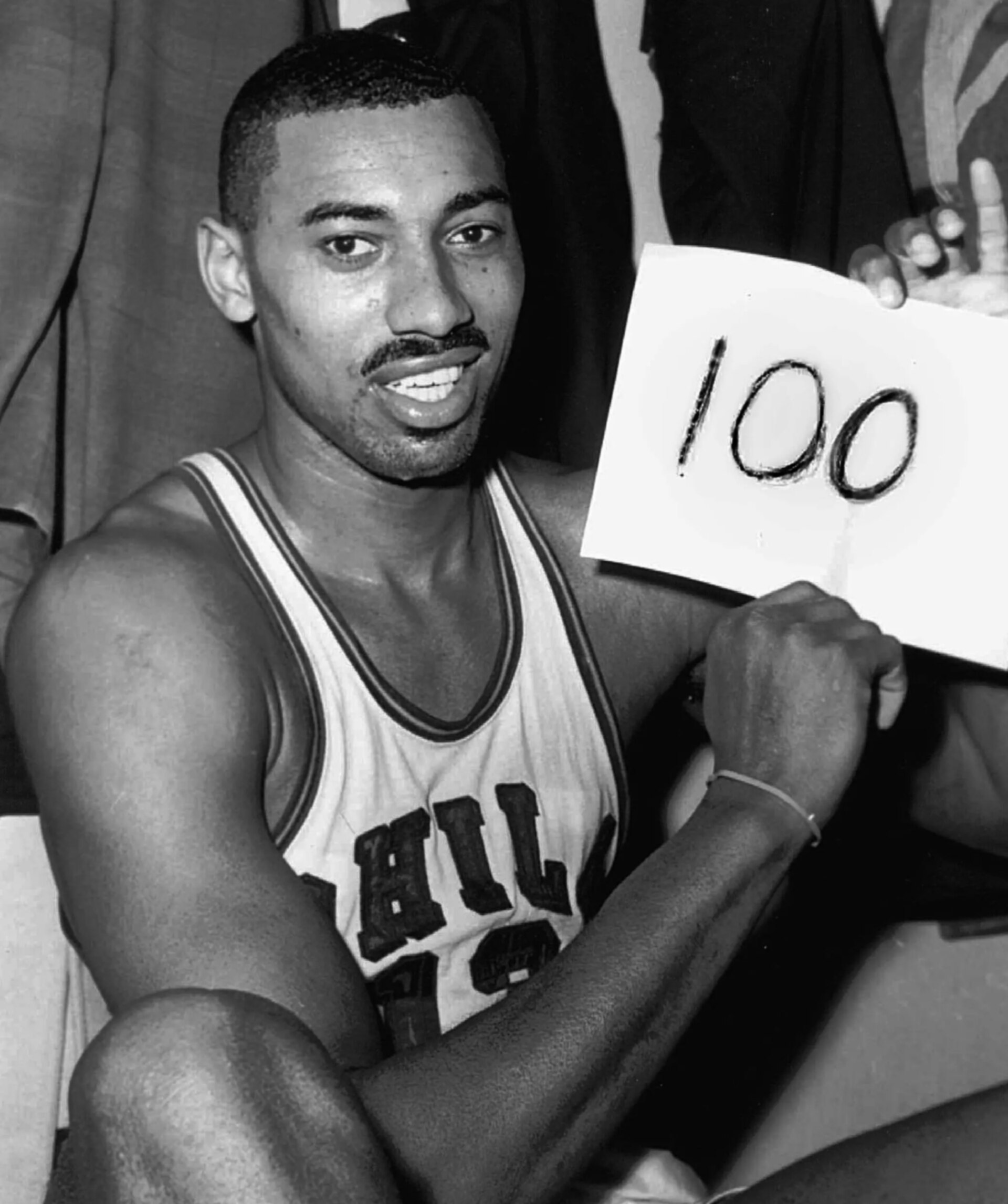
Wilt Chamberlain's 100-point game, played on March 2, 1962, is one of the most iconic and unbreakable records in NBA history. The legendary performance took place at the Hershey Sports Arena in Hershey, Pennsylvania, during a regular-season game between Chamberlain's Philadelphia Warriors and the New York Knicks. Wilt’s 100 points in a single game remains the highest-scoring performance ever by an individual in an NBA game, a record that has stood for over six decades and remains untouched.
JamesOn Curry's Short-Lived NBA Career (2010)
Some NBA careers end almost as soon as they begin, underscoring the league's intense competition and unpredictability. JamesOn Curry's career is a prime example. Drafted by the Chicago Bulls in 2007, Curry played just 3.9 seconds in his only NBA game with the Clippers in 2010, setting the record for the shortest NBA career.
Curry's journey vividly illustrates the challenges of maintaining a professional sports career. After his brief NBA appearance, he spent time in the NBA Development League and Europe, highlighting the fierce competition and limited opportunities many players face. Injuries can derail even the most promising careers, making NBA longevity precarious.
Amazing 50-Point Performances
Here are four 50-point performances that left fans in awe:
- Mo Williams: On January 13, 2015, Mo Williams shocked everyone by scoring 52 points for the Minnesota Timberwolves. His season average was only 11.0 points per game, making this a truly astonishing feat.
- Vernon Maxwell: On January 26, 1991, Vernon Maxwell dropped 51 points against the Cleveland Cavaliers, with a jaw-dropping 30 points coming in the fourth quarter alone. It was a night to remember.
- Caris LeVert: On March 3, 2020, Caris LeVert scored 51 points, with 37 of those points coming in the fourth quarter and overtime. Before this game, his career high was just 37 points.
- Willie Burton: On December 13, 1994, Willie Burton scored 53 points, even though he had only one other game in his career with over 30 points.
These games serve as a reminder that in the NBA, anything can happen on any given night.